
How to Use the STAR Method: Turn One Resume Bullet Into an Interview Answer
Your resume bullets already hold half of every STAR answer. This guide unfolds one real bullet into a spoken interview answer, part by part, and shows what to add from memory.
10 min read · By Vinicius Ponde
"Tell me about a time you improved a process." Most people know STAR stands for Situation, Task, Action, Result. The answer still tends to come out as two minutes of background, or as a resume bullet read aloud.
Both problems have one cause. A resume bullet is a STAR story with the beginning cut off and the size of the ending squeezed out. Learning how to use the STAR method is mostly putting those parts back, and only you can supply them.
This guide takes one bullet from my own resume and unfolds it, step by step, into the answer I would give in an interview.
Each STAR Part Answers One Question, and the Action Takes Half the Time
A STAR answer is four short answers in a fixed order.
| Part | The question it answers | Time in a two-minute answer |
|---|---|---|
| Situation | What was wrong, and where? | About 15 seconds |
| Task | What was yours to do about it? | About 15 seconds |
| Action | What did you do? | About a minute |
| Result | What changed, and by how much? | About 30 seconds |
The split is a rule of thumb. The shape is what matters: a short setup, a long middle, and an ending with a number or a concrete outcome in it. The Action gets the most time because it is the part the interviewer is listening for.
Your Resume Bullet Already Holds the Action and Part of the Result
Here is the bullet, from my data analyst job at SumUp, a merchant services company, in São Paulo:
Reduced customer service demand by 10% by increasing the first time resolution rate of inquiries. Built a hypothesis tree, ran A/B tests, researched best practices and led a multi-disciplinary team to create a script for support agents.
Read it against the four questions:
- Action: plenty. A hypothesis tree, A/B tests, research, and a team I led.
- Result: half there. Demand fell by 10% because more inquiries were solved on the first contact. The bullet doesn't say 10% of what, or over how long.
- Situation and Task: missing. Nothing says what was wrong, who asked, or what the goal was.
That is normal: a resume keeps only what a screener has time for. The guide on how to write resume bullets that show results covers that compression from the other side.
The parts a bullet leaves out live in your memory, and no template can fill them in for you. Start by marking which of the four parts your bullet contains.
Unfold the Bullet by Asking What Came Before and What Came After
Answer four questions from memory, in the order you will say them:
- Situation: what was going wrong? One or two sentences, then stop.
- Task: what was yours? Who gave you the problem, or did you find it yourself, and what was the goal?
- Action: what did you do? The bullet's verbs, in the order they happened, with "I" as the subject.
- Result: what changed, by how much, and over what period?
Write the answers as short notes. Notes keep the facts straight without turning the answer into a script you recite.
- Situation
- The same customers kept contacting support about the same problem.
- Task
- The director asked me to create a First Time Resolution metric, then to improve it once I had defined it. No target: it was a new problem, and we weren't sure the metric could move.
- Action
- #
- Result
- More inquiries solved on the first contact. Customer service demand down 10% over about three months.
Said out loud, the notes become this:
Reduced customer service demand by 10% by increasing the first time resolution rate of inquiries. Built a hypothesis tree, ran A/B tests, researched best practices and led a multi-disciplinary team to create a script for support agents.
At SumUp in São Paulo, the same customers kept contacting support about the same problem. The director asked me to create a First Time Resolution metric, and once I had defined it, to improve it. There was no target: it was a new problem, and we weren't sure the metric could move at all. I built a hypothesis tree around one question: why do customers contact us again? I researched best practices, then led a group of support agents and team leads, with an operations manager as a key stakeholder, to write a new script for support agents. I tested it with an A/B test: teams using the new script against teams still on the old guidelines. More inquiries were solved on the first contact, and customer service demand fell by 10% over about three months.
The two hold the same facts in a different order. A bullet starts with the result. A story ends with it.
Four Mistakes That Make a True Story Sound Weak
Too Much Situation Buries the Action
A frequent opening covers the company, the team, the product and its history before anything happens. In the answer above, the company gets one phrase: what it does and where.
"We" Hides What You Did
Most work is team work, so "we" feels honest. It also leaves the interviewer unable to tell what you did. "We worked on the support script and brought demand down" could describe anyone on the team. "I built the hypothesis tree, ran the A/B tests and led the team that wrote the script" describes one person. Name the team once, then make yourself the subject.
An Answer With No Result Has No Ending
A bullet without a Result tends to become an answer without one. Here is another bullet from the same job:
Led the customer experience turnaround of a prepaid card. Performed customer interviews, led focus groups, ran data analysis, led problem-solving sessions with cross-functional teams, and wrote business requirements.
Every verb is an Action. Nothing says what changed for the card or its customers, so the story stops where the interviewer's real question starts: did it work? If you never saw the final numbers, say what you saw change before you moved on.
A Result With No Size Is Hard to Picture
"Demand fell by 10%" beats "demand fell". The listener still can't tell whether that meant a few dozen contacts or thousands. Add the base and the period. If you don't remember exact figures, give a range you could explain if asked.
Sometimes the base is gone. I no longer remember how many contacts a month my 10% came from. Don't make one up: you may be asked how you got it. Give what you can stand behind instead: the period, and how the change was measured. Mine compared teams using the new script against teams still on the old guidelines, which is what makes the 10% believable.
Match the Story to the Question by Stretching a Different Part
Behavioral interview questions usually start with "Tell me about a time" or "Give me an example of", and each one asks about a skill. "Why do you want this job?" is not asking for a story, so STAR doesn't fit it.
One story can answer several questions. Keep all four parts, and spend the extra time on the piece of the Action that shows the skill being asked about:
- "Tell me about a time you improved a process." Stretch the hypothesis tree: how you found the cause before changing anything.
- "Tell me about a time you led people from other teams." Stretch the team: who was in it and how you ran the work.
- "Tell me about a time you used data to make a decision." Stretch the A/B tests: what you compared and what the results told you.
Prepare One to Three Stories per Job, Then Check Them Against the Job Description
You can't prepare separate STAR interview answers for every question. A small set of stories, each able to answer several questions, is easier to remember and to adapt.
Take your two or three most recent jobs and unfold one to three bullets from each, starting with the ones that have a clear Result. That gives you roughly five to eight stories. Then list the skills the job description asks for most, and check that each one points to a story. Fill any gap from an older job or a project.
The data analyst job in this example holds two: the support script and the prepaid card turnaround, and each one answers different questions.
How to Apply This
Unfold one bullet before your next interview
- Pick the bullet on your resume with the clearest Result.
- Underline the Action and circle the Result. Whatever is left unmarked is what you need to remember.
- Write short notes for all four parts, with "I" as the subject of every action that was yours.
- Say it out loud with a timer. Aim for about two minutes, with half of it on the Action.
The Interview Asks for What the Resume Had to Cut
A resume has room for what you did and what came of it. An interview has room for the rest: what was wrong, what was yours, and how big the change was.
Those parts were cut for space, and they come back when you ask each bullet the four STAR questions. Preparing STAR answers is mostly remembering, and your resume already tells you what to remember.
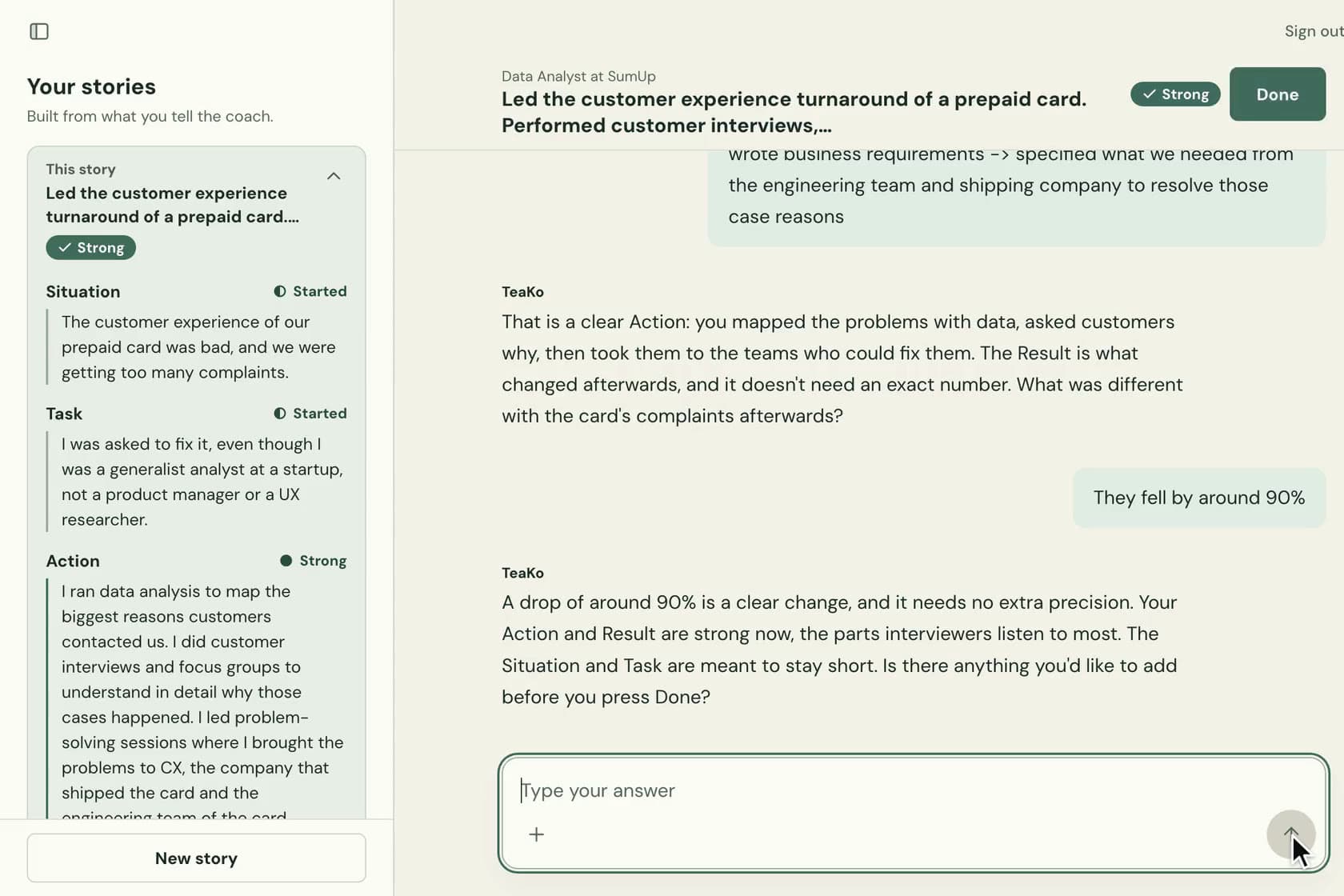
Doing this for every bullet takes a while, and it is easy to stop at the Action. At /star, pick one line from your resume or describe a project. A coach asks you one question at a time about the parts the line leaves out, and builds the story only from what you tell it. When you press Done, the story gets a title and the traits it shows. Your first story is free.